Which Crew Do You Belong To?

WHICH CREW DO YOU BELONG TO? (Part 2)
III John
If you remember from my last article, we started looking at the little New Testament postcard from the Apostle John to his dear friend Gaius, writing about a problem that was occurring in the church where Gaius was a member. John contrasts two types of people in the church: the building crew, represented by Gaius and Demetrius, and the wrecking crew, represented by Diotrephes. We saw last time THE TOOLS OF THE BUILDING CREW, which are love, truth, prayer, spiritual growth, sincerity, encouragement, ministry and missions. Those are the kinds of attitudes and actions that would build up any church.
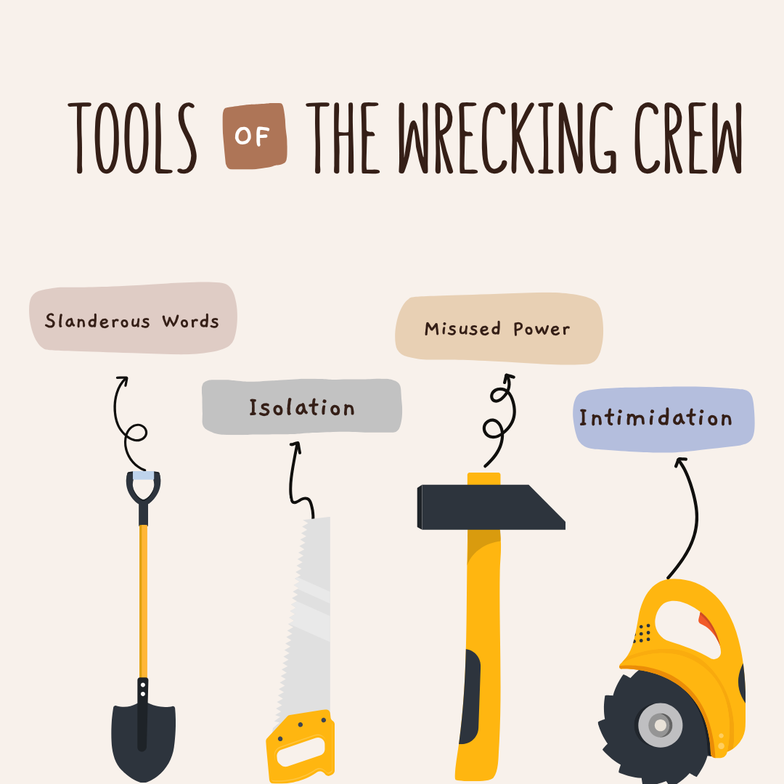
In this article, I want us to look at Diotrephes and THE TOOLS OF THE WRECKING CREW, which are delineated in verses 9-10.
A. Self-centeredness: John says that Diotrephes “loved to be first.” Jerry Vines tells about how when he was a child, there was only one football in the whole community, and all the kids would get together and play. The problem was that the kid who owned the football loved to be first, and he made up the rules as he went along to make sure that not only did his team win, but he was the hero, and the reason he got away with it was because if things didn’t go his way, he took his football and went home. Diotrephes’ name indicates that he was from the aristocracy, and it was likely that he was a rich man. The church may have met in his home, or he may have been a heavy contributor to the finances of the church, or he may have just had a forceful personality, but for whatever reason, he had power, and he used it not to do good, but to exalt himself. That kind of selfishness cannot help but tear down a church.
B. Rejection of Authority: John was an apostle, and by this time most likely the only one of the apostles still living. The apostles were that group of men who had walked with Jesus during His earthly ministry and were especially commissioned by Him to establish the early churches and communicate authoritative doctrine, but despite that fact, Diotrephes would not accept what he said. Many today are rejecting the apostles’ authority by questioning, rejecting, or ignoring the apostles’ teaching as found in the Bible. When the church cuts itself loose from Biblical authority, and lets other things, like personal opinion, or tradition, or so-called “church growth strategies” take precedence, the church will be torn down.
C. Slanderous Words: The Greek word is phluareo, which means literally “to babble on and on incoherently.” His words had no basis of truth in them, but when gossip is repeated often enough, no matter how absurd it may be, it will come to be believed. The Bible says, “Let no unwholesome word proceed from your mouth, only such a word as is good for edification (or “building up”).” In other words, we need to think before we speak. Will what I am about to say build up the church, or tear it down? If our words are going to tear down someone or the church as a whole, the Bible says to swallow them. When slanderous words abound in the church, the church is torn down.
D. Isolation: You remember from last time how the older apostle John was training up younger men as missionaries and sending them out to the established churches to preach. They would go to the first church, minister there and build up the church, then the church would take up and offering of money and goods to get them to the next church, and then to the next, and when they reached the furthest church, that last offering would launch them out to go preach the gospel where it had never gone. Diotrephes, John said, would not receive the brethren, and in that refusal he was throwing a monkey-wrench in this missions strategy and cutting off the church from cooperative missions with other churches. I believe whole-heartedly in the concept of the autonomy of the local church, that each local church must make its own decisions under God without any outside pressure. But I also believe that each church should cooperate with other churches in the larger work of the Kingdom, because as we work together, we can accomplish far more together than we could doing the same work individually.
E. Intimidation: Not only would Diotrephes not receive these men; he intimidated others into refusing them lodging and help.
F. Misused Power: Those who did give the missionaries help, he put them out of the church. Folks, no one person, and no small group within the church, should have that kind of power. Decisions about the membership, the mission and the money of the church must be made by the congregation at large, and not by one or two influential members.
In verse 11, John urges us, “Beloved, do not imitate what is evil, but what is good.” As Christians, let us commit ourselves to emulate people like Gaius, who was part of the building crew of the church. Let us be marked by the things that build up the church: love, truth, prayer, spiritual growth, sincerity, encouragement, ministry, and missions. Let us determine never to be part of the wrecking crew, with its self-centeredness, rejection of authority, slanderous words, isolation,
intimidation, and misused power. Let’s make it our intention to never be part of the wrecking crew, but to always be a part of the building crew as we serve the Lord together here at CBC.