Which Crew Do You Belong To?

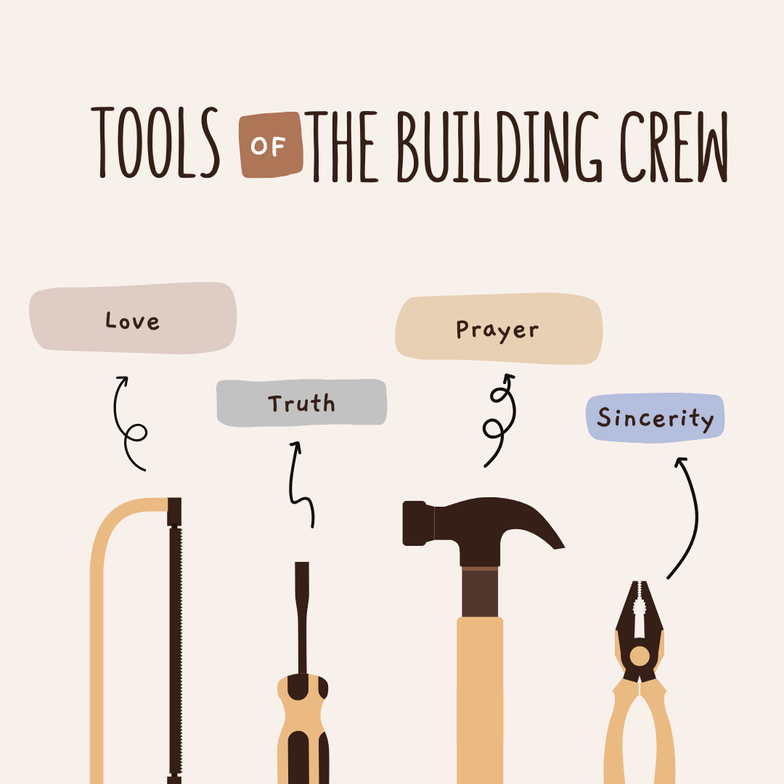
TOOLS OF THE BUILDING CREW
III John
Martin Thielen was an editor with what used to be the Sunday School Board in Nashville. One day he decided to take a walk on his lunch hour, and as he walked down Church Street, he saw an old building that was scheduled for demolition. In front of it was the sign of the wrecking company, along with its motto: IF IT WAS BUILT, WE'LL WRECK IT! As he walked away, he chuckled to himself at the irony of that sign being on Church Street. That is the theme of the little New Testament postcard III John. It speaks of those who build up the church and those who tear it down, or as we might call them, the building crew and the wrecking crew. When this book was written, the Apostle John was a very old man. He was the last of the apostles still alive, living in Ephesus, unable to move about like he once did, but he is training and commissioning younger men and sending them out to preach the good news of Christ. These younger men would travel to the established churches, stay with them a short time to teach and edify them, and then the church would take up a love offering of money and goods to send them on their way to the next church. When they came to the end of the line, they would take the final love offering and launch out into the unknown, taking the gospel to places where it had not gone before. But the whole system was being threatened by one man, a church leader named Diotrephes who rejected the authority of John and refused to support these young missionaries. In this article, we can see the tools of the building crew today, and then we’ll look at the tools of the wrecking crew in my next article.
THE TOOLS OF THE BUILDING CREW.
A. Love (v. 1). John speaks so often of love in his letters that he has become known as theApostle of Love. But he wasn’t always that way. In the gospels, John is a quick-tempered, unforgiving, angry man, so full of bluster that Jesus called him and his brother “Sons of Thunder” - a lot of hot air and noise. What was it that so changed John’s personality? Very simply, it was Acts, chapter 2. When the Holy Spirit came upon the disciples on the Day of Pentecost, all of them were radically changed. Peter was changed from a weak, vacillatingman to a man of immense courage, and John, who had once wanted to call down fire on villages that rejected Jesus, became a man of love and compassion. The Bible is clear that the first fruit of the Spirit is love - agape’, God’s kind of love, love for the unlovely and the unlovable, love that always wants the best and always does the best for the other person, even at great personal cost. When we are truly in Christ, controlled by His Spirit, it will manifest itself in love for one another, and where there is mutual love in the church, the church will be built up.
B. Truth: John says that he loves Gaius “in the truth.” Truth and love must be held in balance in the church. Churches that have the truth but are unloving quickly become prideful, abusive and legalistic, using the truth (or their version of it) to batter their members into conformity. On the other hand, churches that are weighted toward love without regard to the truth become afraid to confront sin lest someone be offended, and before you know it, they become dens of iniquity and license rather than churches of Jesus Christ. Love and truth must always remain in balance. As the apostle Paul put it, it’s only when we speak the truth in love that we grow up in every aspect into Christ, who is the head of the church.
C. Prayer: John says in verse 2 that he is praying for Gaius. I think it almost goes without saying that that the church as a whole is built up when its members are praying for one another. And the content of John’s prayer points us to another tool of the building crew:
D. Spiritual Growth: John prays that his friend’s prosperity in the material realm - his health and his finances - might prosper to the same extent that his spiritual life is prospering. I wonder how many of us are walking close enough to the Lord that we would want such a prayer offered for us? Would we really want our physical health to be on the same level as our spiritual health? Would we really want our finances to reflect our faithfulness? When we are walking close enough to the Lord and growing in Him enough for the answers to those questions to be yes, we will truly be the kind of members that build up the church.
E. Sincerity (vv. 3-4). John says that word has gotten back to him in Ephesus that Gaius is walking in the truth; in other words, he is walking his talk, not just putting on a mask on Sunday, but living a lifestyle that is in accord with his commitment to Christ every day. John says that hearing that about his converts is his greatest joy in ministry, and it is mine as well. My greatest joy is not when someone makes a profession of faith, because many have been the professions of faith that have not proven true. My greatest joy is to be able to look at someone several years later and see a truly changed life and a committed walk with the Lord that proves their faith is genuine.
F. Encouragement. Other people have been bragging to John about Gaius and John is now telling Gaius what they’ve been saying about him. Wouldn’t it be wonderful if the church grapevine only carried messages of encouragement! Sometimes churches can be the exact opposite of the home on the range - a place where seldom is heard an encouraging word! And how often it is that discouragement travels that way: someone talks down someone else, and then that person runs to the person who’s been talked about and tells him all about it. Mark Twain once said that it takes your enemy and your friend working together to cut you to the heart: your enemy to slander you, and your friend to get the news to you! It’s amazing how negative we can be sometimes. When people are doing well, we say nothing, but when they mess up, we jump all over them. Let us make the commitment to be encouragers, to speak words of appreciation for others’ service and lifestyle, to tell people when other people speak well of them. In I Thessalonians 5:11, Paul writes, “Therefore encourage one another, and build up one another.” Note the close connection between the two. When we are encouraging one another, the church is built up.
G. Ministry (v. 5a). John speaks there of Gaius acting faithfully in service to the brethren. True faith always expresses itself in ministry, both ministry to those within the body and those without. And that is what verses 5b-8 speak of, the tool of missions. John commended Gaius because his concern looked farther than just his local church and local community; he had such a desire to see the gospel spread to others that he supported the work of John’s missionary force. As Southern Baptists, we have always been a missions-minded people. I believe that our denomination and individual churches have been blessed because we have refused to get a narrow focus, concerned only for ourselves, and have instead turned our eyes outward to the mission fields. Don’t ever think of missions support as being a detriment to the ministry of the local church; it is a tool by which God blesses us and builds us up. John says that when we support the work of those who are called to take the gospel to those new work areas, we become fellow workers with them, and God rewards us accordingly.